Curved End Straps vs. Flat End : How To Choose Guide

Curved End Straps vs. Flat End Straps

When choosing a replacement watch strap, matching the lug width is only the first step.

Most watch straps on the market use a standard flat or straight end. However, some watches require a curved end strap because their spring-bar holes are positioned very close to the edge of the case or because the original strap was designed with a curved end.

At the same time, a curved end does not mean that the strap will completely eliminate the gap between the strap and the watch case.

Understanding the difference between flat-end straps, curved-end straps, curved spring bars, and straps with lug adapters or connectors will help you choose the right replacement strap.

What Is a Curved End Watch Strap?

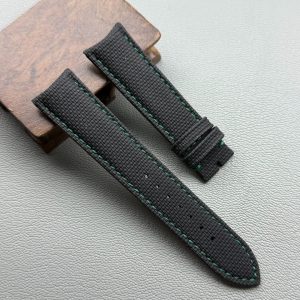
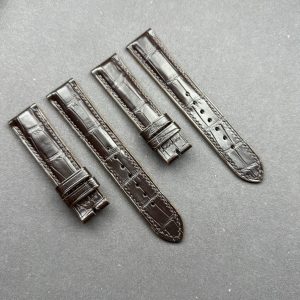
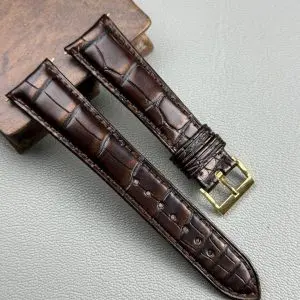
A curved end watch strap is a strap with a curved connection area where it attaches to the watch case.

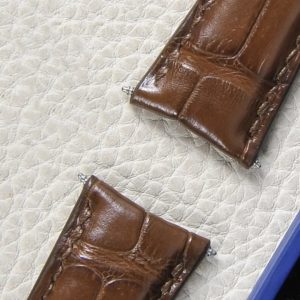
It is normally used together with a curved spring bar, allowing the spring bar and strap to clear the edge of the watch case.

Compared with a traditional flat or straight-end leather watch strap, a curved end can follow the case geometry more closely.

Curved end straps can be particularly useful for watches with:

  • Very short lugs
  • Spring-bar holes positioned very close to the case
  • Limited clearance between the spring bar and case
  • An original OEM strap with curved ends

For most watches, however, a straight-end or flat leather watch strap remains the safer and more versatile option.

What Is a Curved End Watch Strap

Why Is My Strap the Right Size but Still Doesn't Fit?

This is a common misunderstanding when replacing a watch strap.

Suppose your watch has 20mm lugs. A 20mm curved end leather strap and a 20mm flat leather strap may both match the lug width, but that does not mean they will have the same fit.

Lug width only tells you the distance between the lugs.

You also need to consider:

  • The position of the spring-bar holes
  • The length of the lugs
  • The shape of the watch case
  • The clearance between the spring bar and case
  • The construction of the original strap
  • Whether the watch was designed for a straight or curved strap end

This is why a curved end leather strap may work perfectly on one 20mm watch but create an unnecessary gap on another 20mm watch.

The same applies to 21mm curved end leather watch straps and 22mm curved end leather watch straps.

Correct width does not always mean correct construction.

Why Is My Strap the Right Size curved end strap but Still Doesn't Fit
Why Is Strap the Right Size curved end strap but Still Doesn't Fit

Curved End vs. Flat End: Which Should You Choose?

For most watches, we recommend a flat or straight-end strap unless there is a specific reason to use a curved end.

A curved end makes sense when a straight spring bar would hit the watch case due to very short lugs, leaving no clearance between spring‑bar and case. Under this condition, a flat / straight‑end leather strap will bind, scrape the case, and wear out the strap joint quickly.

A flat-end leather watch strap is generally the better choice for rectangular watches, such as the Jaeger-LeCoultre Reverso, Cartier Santos, and Cartier Tank. The straight lines of a flat-end strap are more consistent with the geometric design of these cases, while a curved-end strap may look visually mismatched.

For short-lug round watches, choosing between a curved spring bar and a straight spring bar—and therefore between a curved-end strap and a flat-end strap—is less straightforward.

You may need to choose between:

A smaller or nearly invisible gap with some contact or rubbing — choose a flat-end strap.
A visible gap with little or no rubbing — choose a curved-end strap.

A straight-end strap is therefore not a lower-quality option. In many cases, it is simply the construction that best matches the watch’s design and the wearer’s priorities.

Curved End Strap vs. Lug Adapter or Connector

One of the biggest misconceptions about curved end watch straps is that they will always make the strap sit closer to the case.
A curved spring bar changes the shape and angle of the connection, but it does not move the spring-bar holes on the watch.

Therefore, if a watch was originally designed for a straight-end strap, installing a curved end can actually move the strap farther away from the case and create a larger visible gap.

A curved end is not automatically a better fit.

Curved End Strap vs. Lug Adapter or Connector

Why Do Some Watch StrapsNeed an Adapter

A lug adapter, connector, or end link is a separate component that fills the space between the watch case and the strap.

It is specifically shaped to match the case and can create a much more integrated appearance.

This is fundamentally different from simply using a curved spring bar.

A curved spring bar changes the position and angle of the spring bar.

A lug adapter physically fills the space between the case and strap.

Therefore:

Curved end strap ≠ integrated strap.

If the original factory strap uses a metal adapter or connector, a curved spring bar alone generally cannot reproduce the same fully integrated, factory-style appearance.

For more information, see our guide:Watch Strap Gap: Straight-End vs. Straps With Lug Adapter

How Can You Tell If Your Watch Needs a Curved End?

There are several simple ways to determine whether you need a curved end.

1. Check the Original OEM Strap

The original strap is often the best reference.

If the factory leather strap has a curved end, replacing it with a similarly shaped curved end strap is usually the safest approach.

If the original strap has a simple flat end, a straight-end replacement will usually be appropriate unless the watch has a specific clearance issue.

2. Check the Position of the Spring-Bar Holes

Look closely at the spring-bar holes.

If the holes are extremely close to the edge of the watch case, a straight spring bar may come into contact with the case.

In this situation, a curved end strap can provide better clearance.

3. Check the Lug Length

Shorter lugs are more likely to require curved end straps.

If the lugs are relatively long and there is plenty of space around the spring bar, a flat leather watch strap will often look better.

This is why simply looking at the lug width is not enough.

Common Watches That May Benefit From Curved End Straps

Curved end straps are particularly relevant to watches with short lugs or factory-designed curved strap connections.

Depending on the exact model, examples may include certain watches from:

  • F.P. Journe
  • Ming
  • Vacheron Constantin
  • H. Moser & Cie.
  • Jaeger-LeCoultre
  • Other watches supplied with curved-end OEM straps

FAQ

Q:Is There an Extra Fee for Curved Ends?
A:No.Royalwatchstrap does not charge an additional fee for curved ends.

Q:Are Curved End Straps Available in Different Materials?
A:At Royalwatchstrap, you can choose from different leather finishes, colors, stitching styles, and strap constructions while keeping the appropriate curved-end design.

Q:Why Are Curved Rubber Watch Straps Less Common?
A:Curved end designs are more commonly found on custom leather straps than mass-produced rubber straps.
Leather is relatively easy to customize. The strap end can be shaped according to the specific requirements of a particular watch.

Q:Does Royalwatchstrap recommend the correct end shape?
A:Yes.Before ordering a custom strap, you can provide your watch model or photos of the watch and original strap.

Leave a Reply

Your email address will not be published. Required fields are marked *